
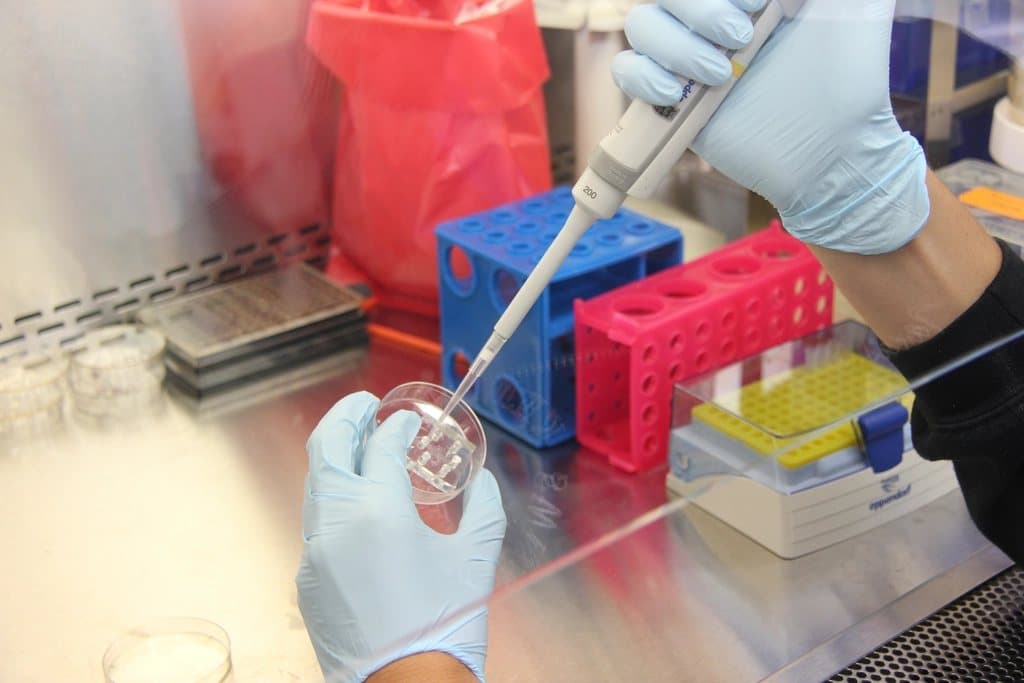
Calibration establishes what an instrument can do. Technique determines what it actually does at your bench. These are the five issues we find most often, in rough order of how much volumetric error they contribute.
1. Laying a pipette on its side with liquid in the tip
Liquid runs back into the shaft, contaminates the piston and seal, and starts corroding both. This is the single most damaging habit we see, and it is entirely a storage problem. Hang instruments vertically on a stand. Always.
2. Skipping the pre-wet
The first aspiration into a dry tip loses volume to the tip wall and to vapor equilibrium in the headspace. Aspirate and dispense once before the measured draw, and do it every time you change tips — not just once per session.
Pre-wetting is worth 1–2% on aqueous samples and considerably more on volatile organics. It is the highest-return habit on this list and it costs three seconds.
3. Inconsistent immersion depth and dispense angle
Immersion should be shallow and consistent — two to three millimeters for small volumes. Deep immersion carries liquid on the tip exterior; shallow immersion aspirates air. Aspirate with the pipette vertical, dispense against the vessel wall at ten to forty-five degrees, and keep it the same every time.
4. Thermal disequilibrium
Gravimetric calibration assumes instrument, liquid, and tips are all at ambient temperature. A pipette warmed by a hand for twenty minutes, a reagent straight from 4 °C, or tips stored beside an incubator all introduce error the calibration certificate never accounted for. Let everything equilibrate.
5. Rushing the aspiration
Releasing the plunger fast, especially with viscous or volatile liquids, leaves the volume short because the liquid column never catches up with the piston. Let the plunger return under control over roughly a second, and pause a beat before withdrawing from the liquid.
The pattern underneath all five
Every one of these produces a real volumetric error on an instrument that will pass calibration perfectly. That is the point worth internalizing: calibration bounds the instrument, not the result. A program that calibrates on schedule but never observes technique has secured one half of the problem.
This is one of the underrated advantages of on-site service. Our technicians watch people pipette, and the conversation that follows fixes more error than the adjustment does.
Next step
Want this reviewed against your own program?
Send your asset register and last certificates. We’ll reconcile the list, flag what’s overdue, and tell you what we would change.
Get started